Buried
history
American Graveyard is a feature-length documentary that begins not with an answer, but with a rupture: how do you reclaim a past that has been deliberately erased?
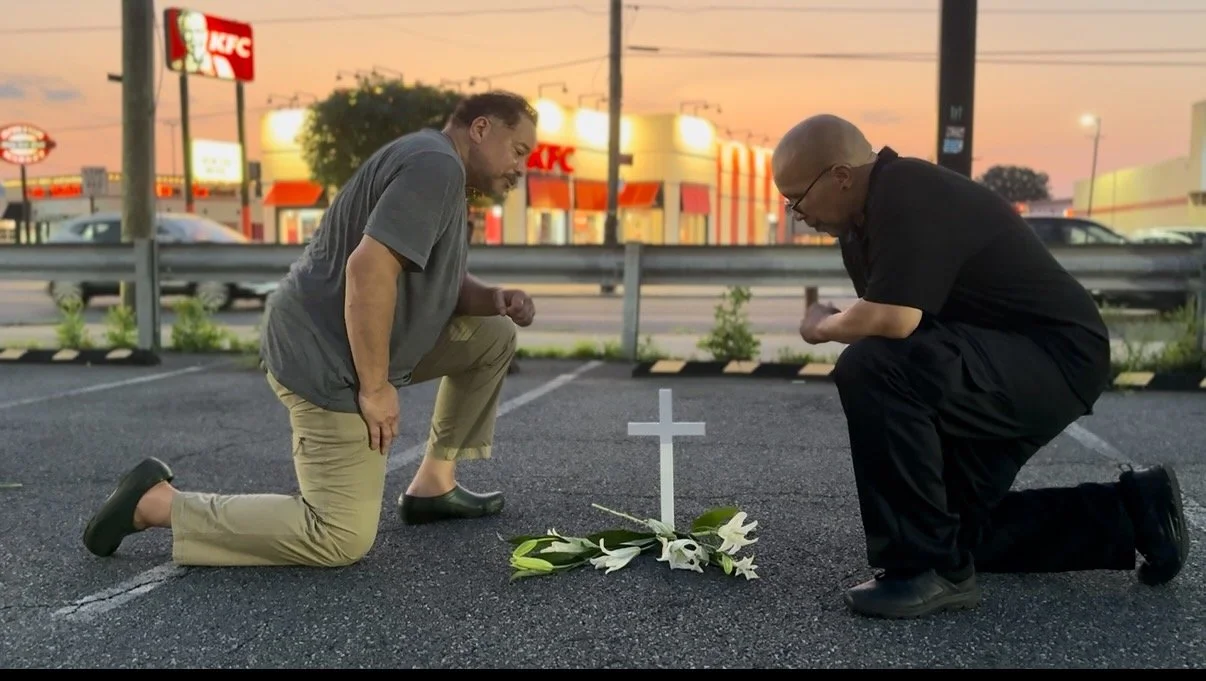
At its center is Cherry Lane Cemetery, a 19th-century African-American burial ground on Staten Island, New York. The land was deeded in 1850 for an AME Zion Church, and segregated burials meant the cemetery became an extension of that land. It was the final resting place of free and formerly enslaved people whose lives moved through the Atlantic world—New York and New Jersey, Maryland, Virginia, the Carolinas. In the 1950s, the cemetery was bulldozed and paved over, first for a Shell station, then for a shopping plaza. No mass reinterment. No marker. No public reckoning.
Rather than smoothing that absence into a seamless narrative, American Graveyard treats history as pentimento: a surface scraped clean and repainted, where earlier marks refuse to disappear. Archival records, land deeds, letters, courtroom testimony, descendant memory, and contemporary art are layered visibly atop one another. The film does not simply recount the past; it shows the work of stitching fragments together in the present, making the gaps, contradictions, and erasures part of the story itself.
As the film moves between centuries, Cherry Lane becomes both a specific site and a larger condition—one example within a national pattern of Black burial grounds erased in the name of progress, development, and convenience. The documentary unfolds alongside acts of contemporary repair, including an exhibition that brings descendant voices, artists, and researchers into dialogue with the land as it exists now.
Directed by award-winning filmmaker Heather Quinlan (If These Knishes Could Talk: The Story of the NY Accent; Spoke; Dinner with Wise Guys), American Graveyard is less a traditional historical account than a reckoning with how history is made, unmade, and sometimes reclaimed. It asks what it means to remember when the ground itself has been rewritten—and what obligations the living carry to those still beneath the pavement.